
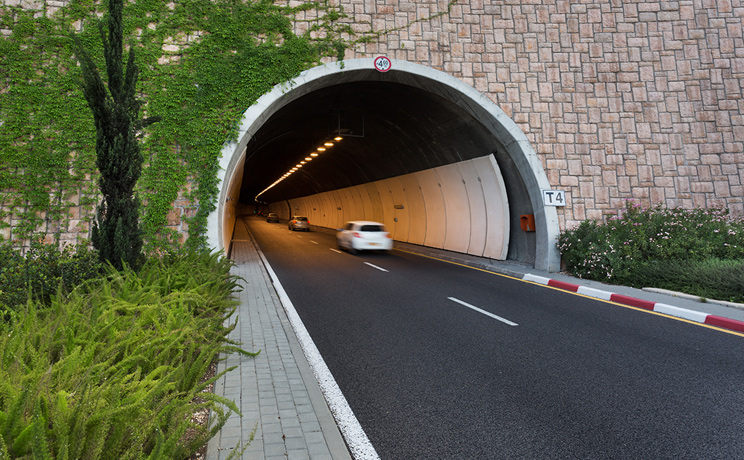
 About the Carmel Tunnels
Some Data
- The Carmel Tunnels is one of the largest and most complex infrastructure projects ever built in Israel using the B.O.T. (Build – Operate – Transfer) method.
- The project includes two pairs of tunnels and a central interchange, the largest of its kind in Israel.
- The concession agreement stipulates that the company will be entitled to collect a transit fee in exchange for planning, construction, operation, maintenance of the project and its return to Israel at the end of the concession period.
- The concession agreement between the State of Israel and Carmelton is for 35 years, including 5 years of construction and 30 years of operation.
- The project connects Haifa’s western entrances to the eastern entrances and allows easy entry into the city.

Milestones
- 1992 – Early Screening Process
- 1997 – Announcement of the Tender
- 1997 – Carmelton Wins the Tender
- 1999 – Financial Closure
- 2002-2006 – Completion of statutory procedures, change in shareholder composition, amendment to the concession agreement, financial closing update and signing of a financing agreement
- 2007 – Construction Work Begins
- 2010 – Opening of the Project for Traffic
- 2014 – Opening of the Direct Connection between the Carmel Tunnels and the Krayot Bypass Highway

The Story of the Tunnel, the Story of Israel
The history of the Carmel Tunnels project dates back to the British Mandate period, when initial plans for digging a tunnel through the Carmel range emerged. The original idea was to create free passage for vehicles that would begin in Syria and extend across Israel to the seashore. This was part of a strategic security plan, in the belief that this would strengthen the British’s hold on the region, but they did not have time to implement the ambitious plan until the end of the British Mandate in Israel. The idea of carving a road through Mount Carmel was revived in the late 1980s, and in the late 1990s the tender was launched – but it was not until the 2000s that the decision was made to actually carry out the project. The Carmel Tunnels are a complex and challenging project, which required in-depth planning by mining experts. The main challenge: How to carry out the work efficiently, with minimal disruption to the daily routine of Haifa residents, while preserving the quality of the environment, and considering sustainability and preserving the natural values of the area.

A Project of Unprecedented Scope
About 1,000 workers from Israel and China worked for about 3 years to implement the project, they carried out about 5,000 controlled explosions, removed 2,500 tons of dirt using 300 trucks, and built eight new bridges. The tunnels were dug using the “drill and blast” method, by drilling into the rock and inserting dynamite into the drilled holes. The drilling location and the amount of explosive type were calculated by engineers to reach the desired tunnel dimensions. The explosions were carried out in a controlled manner so that they had no effect on the houses above. In January 2007, the companies Ashtrom and Shikun & Binui began working on the project. Two years later, mining of the 1,643-meter-long eastern pair of tunnels from the Check Post to the Ruppin Interchange was completed. The excavation of the third tunnel, from the Hof HaCarmel to the Ruppin Interchange, 3,200 meters long, was completed six months later, followed by the parallel tunnel. The tunnels opened for traffic on December 1, 2010, about six months before the date set in the updated contract.
Removing the Last Obstacle
Work on the ground started at the beginning of 2007. Two years later, the excavation of the first tunnel, 1,643 meters long, from the Check Post to the Ruppin Interchange in Neve Sha’anan, was completed. The tunnel was dug on one side by the Chinese company CCECC and on the other side by the Israeli company Y. Lerer Ltd. When the two teams arrived facing each other, a controlled explosion was carried out that removed the last obstacle. The excavation of the parallel tunnel was completed on February 25, 2009. The excavation of the third tunnel was completed on May 5, 2009, and the excavation of the fourth tunnel was completed on July 21, 2009. The tunnels’ inauguration ceremony was held in the presence of Prime Minister Benjamin Netanyahu on November 30, 2010, and the following morning the tunnels were opened to vehicle traffic.
