
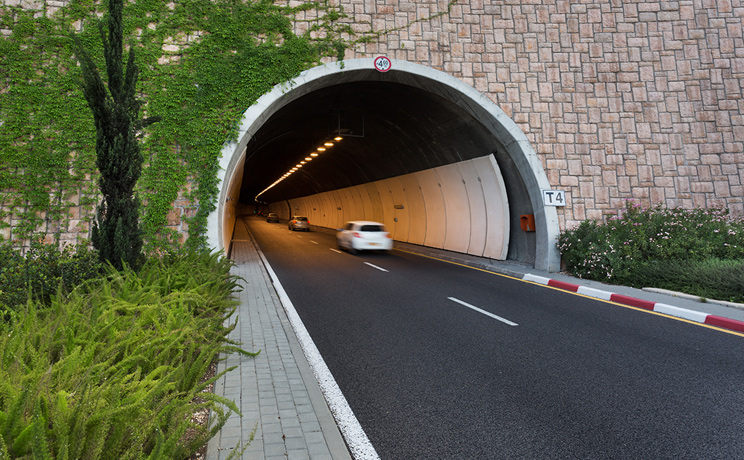
 About the Carmel Tunnels
 The construction of the Carmel Tunnels was done with the utmost consideration for the environment, because the quality of the environment is just as important to us as the quality of your trip. Therefore, we take many actions to preserve and nurture the environment, for the benefit of the residents of Haifa and the entire region. Driving through the tunnel saves time, fuel, and the emission of dangerous gases, and helps reduce environmental air pollution.

Monitoring System
In order to maintain the quality of life of residents in the tunnel area, we have established a monitoring system according to the guidelines of the Ministry of Environmental Protection by leading professionals, including environmental consultants, acoustic experts, and engineers from various fields.
The monitoring system is placed near the tunnel entrances and in nearby residential neighborhoods and performs continuous measurements, 24 hours a day. The monitoring system examines three main indicators: noise, air pollution, and the rate of particles in the air.
The continuous metrics are transferred to advanced computer systems, connected to the Haifa Association of Cities for Environmental Quality and the Carmel Tunnel Authority , which is in charge of the project on behalf of the state.
Other activities we carried out:
- Several noise measurements were taken to ensure that there was no abnormal noise level in the tunnel and its surroundings. The test results showed compliance with all required standards.
- The company operates four air monitoring stations (Co, No, particles) in the project’s vicinity, as well as detectors within the project, to ensure that there are no abnormalities in emission levels.
Landscape and Environmental Restoration
The project cultivated and restored to their former glory over a period of about 3 years, approximately 40 dunams of landscaping areas and natural landscape outside the concession area. As part of the work, thousands of tubers, seedlings, trees and shrubs were planted at the tunnel exits. All plantings were carried out in coordination with the Nature and Parks Authority, the Ministry of Environmental Protection, and the Haifa Municipality. In February 2014, the company returned the areas it had cultivated to the Haifa Municipality.
Wadi Restoration and Landscape Restoration
For decades, the wadi in Nahal HaGiborim was hidden from view, despite its location in the heart of Haifa. Most city residents are almost unaware of its existence, both because of its shape and because of the difficult access to it. Some of its areas were damaged as a result of uncontrolled dumping of construction waste. With the beginning of construction of the Carmel Tunnels, a new road was paved in the heart of the wadi and the garbage was removed from the site by approximately 200 trucks that evacuated the waste to designated sites.
The landscape restoration plan was prepared by landscape architect Margalit Suchoy, in collaboration with agronomist Hanoch Burger. “The uniqueness of the restoration is in the planting of vegetation to a height of tens of meters on the cliffs”, Suchoy explained, “A great deal of attention was paid to preserving the character of Mount Carmel. Soil of the type characteristic of Mount Carmel was brought to the site, as were plants from dozens of different types that grew in the past or grow today in the groves surrounding the city.”

The Largest White Lily Reserve in Israel
The plants planted in the wadi area around the bridges are of a wide variety of types, such as thousands of small lilies, cyclamens, daffodils, bulbs, orchids, and large chives. On an average dunam of land in the project, approximately 70 different plant species grow. Amidst all this, it was decided to plant the largest reserve in the country for the white lily in the wadi. The white lily is considered, according to many beliefs, a symbol of purity and beauty. According to Christian belief, this is a sacred flower, being the plant that Jesus’ mother, Mary, received from the angel who announced to her the expected birth of the Son of God. The importance of the white lily in the Christian religion led to massive displacement by pilgrims from Europe, to a point where the plant almost became extinct in Israel.
The white lily tubers were taken about three years ago from secret growing sites around Mount Carmel. These sites are fenced and carefully guarded by the Nature and Parks Authority. The few tubers were brought to Kerem Maharal, at the disposal of Zion Siman-Tov, one of the veteran growers in Israel.
Restoration of Land Areas, Streams and Interchanges
As part of the project’s construction work, a very comprehensive rehabilitation of all land areas surrounding the three focal points of the project was carried out. At the Check Post Junction, which stood out for its neglect and abandonment for years, thousands of trees and shrubs, typical of the vegetation of Mount Carmel, were planted on the side and irrigation systems were attached to them, designed to help them establish themselves.
Due to the uniqueness of the soil that characterizes Mount Carmel, no equivalent can be found in the usual sites of the Jezreel Valley or the Jordan Valley. However, exceptional timing allowed the use of land excavated in recent months from the mountainside at the entrance to Haifa – for the construction of the Sammy Ofer Football Stadium. The new soil is terra rossa clay soil taken from a depth of 60 cm from the ground, free of seeds and unnecessary salts. 8,000 cubic meters of this soil were moved from the area designated for the stadium to their new home in Nahal HaGiborim.
Three years after its installation, the irrigation system was dismantled and the growth blended into the environment in the most natural way. Adjacent to the road, hundreds of aquatic plants were planted, and a special path was built, leading to the Ein Saadia Stream. The spring has dried up twice in the last forty years for unknown reasons, and hydrologists hope it will flow again. Today, its flow is artificially strengthened.
At the central interchange, olive trees, cypresses, and many other plants were planted that will cover the cliffs surrounding the road network in the coming months. About a month ago, the casting of the “Heroes’ Stream Trail” also began – a long, winding staircase that will connect the Neve Sha’anan neighborhood to the inner part of the wadi and allow city residents to walk in its areas and enjoy the restored nature. The new stairs are being made at the initiative of Carmelton. Beautiful and special plantings were also done at the Hof HaCarmel Interchange, which is actually one of the gates to the city of Haifa.